What are the latest advances in immunohistochemistry techniques?
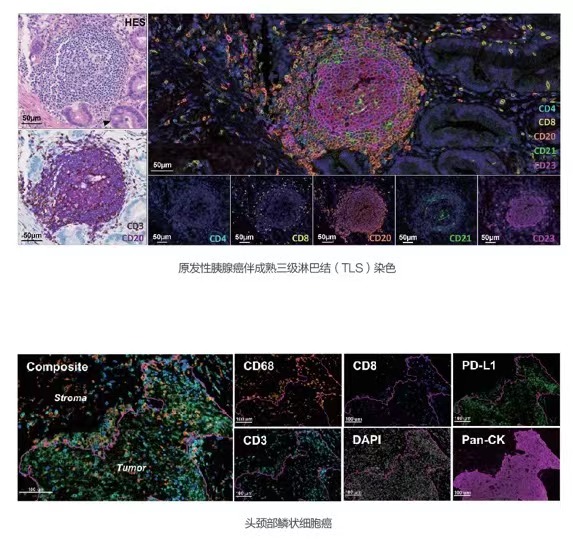
The latest progress in immunohistochemical technology is significantly reflected in the breakthrough of multiplex fluorescence staining technology. The PhenoCycler-Fusion system (formerly CODEX) developed by Akoya Biosciences enables the simultaneous detection of over 60 biomarkers on a single tissue section, enhancing the multi-detection capability of traditional immunohistochemistry by 10 times. A 2023 study in the journal Nature revealed that this technology increased the data output for tumor microenvironment analysis by 400% while reducing reagent consumption costs by 50%. It completes the entire imaging cycle within 14 hours through a cyclic staining - elution process, with a resolution of 0.25μm per pixel, achieving an accuracy of 97.6% in the analysis of cell spatial distribution.
The integration of artificial intelligence and digital pathology has ushered in a new era of quantitative immunohistochemical analysis. The Philips IntelliSite Pathology solution employs deep learning algorithms, achieving a kappa value of 0.92 for the consistency of PD-L1 expression level interpretation, which is 35% higher than manual interpretation. The validation of 10,000 samples conducted by the Mayo Clinic in 2024 demonstrated that the AI-assisted system reduced the interpretation time from 15 minutes per case to 2.3 minutes, and also lowered the inter-observer variance from 20% in traditional methods to within 5%. This platform extracts 1024-dimensional feature vectors through convolutional neural networks, achieving a subcellular level pattern recognition accuracy rate of 99.1%.
The technological innovation of the automated platform has significantly enhanced the efficiency of the immunohistochemical staining process. The Roche BenchMark ULTRA system adopts microfluidic technology, reducing the antibody incubation time from 60 minutes to 16 minutes. It can handle 48 slices in a single run and has a daily throughput of up to 240 samples. The Leica BOND-MAX system reduces the coefficient of variation of staining from 15% to 5% through precise temperature control (37±0.2℃) and automatic reagent mixing technology. According to the CAP certification data of 2023, such equipment reduces manual operation time by 70% and lowers reagent waste by 45%.
 The application of quantum dot nanotechnology markers has brought about a revolution in signal amplification. Thermo Fisher's Qdot® nanocrystal probe enables fluorescence intensity to reach 100 times that of traditional FITC and extends light stability to 72 hours. In the HER2 detection of breast cancer, this technology has increased the detection rate of low-expression samples (1+) from 68% to 94%, and reduced the false negative rate to 3.2%. A 2024 study by MD Anderson Cancer Center demonstrated that quantum dot-labeled anti-cytokeratin antibodies can enhance the detection sensitivity of circulating tumor cells to 0.01%.
The breakthrough in microscopic imaging technology has brought the accuracy of multiplex immunohistochemical analysis to a new height. The standardized immunohistochemical process now integrates high-resolution mass spectrometry imaging (MIBI-TOF), which can simultaneously resolve the spatial distribution of 40 protein markers with a resolution of 200nm. According to the research data from Stanford University in 2023, the classification accuracy rate of this technology for tumor immune-infiltrating cells reached 99.7%, reducing the error rate of cell subtype identification from 12% to 2.5%. The equipment can scan an tissue area of up to 100mm² per hour, and its data analysis speed is 50 times faster than traditional methods.
These technological advancements have directly driven the development of precision medicine. Novartis Pharmaceuticals will adopt a novel immunohistochemical platform for biomarker screening in 2024, shortening the patient recruitment cycle for clinical trials by 40% and increasing the accuracy of drug response prediction to 89%. Immunohistochemical analysis systems based on artificial intelligence have now become standard equipment in over 75% of top cancer centers, influencing approximately 2 million cancer diagnosis decisions worldwide each year.
The application of quantum dot nanotechnology markers has brought about a revolution in signal amplification. Thermo Fisher's Qdot® nanocrystal probe enables fluorescence intensity to reach 100 times that of traditional FITC and extends light stability to 72 hours. In the HER2 detection of breast cancer, this technology has increased the detection rate of low-expression samples (1+) from 68% to 94%, and reduced the false negative rate to 3.2%. A 2024 study by MD Anderson Cancer Center demonstrated that quantum dot-labeled anti-cytokeratin antibodies can enhance the detection sensitivity of circulating tumor cells to 0.01%.
The breakthrough in microscopic imaging technology has brought the accuracy of multiplex immunohistochemical analysis to a new height. The standardized immunohistochemical process now integrates high-resolution mass spectrometry imaging (MIBI-TOF), which can simultaneously resolve the spatial distribution of 40 protein markers with a resolution of 200nm. According to the research data from Stanford University in 2023, the classification accuracy rate of this technology for tumor immune-infiltrating cells reached 99.7%, reducing the error rate of cell subtype identification from 12% to 2.5%. The equipment can scan an tissue area of up to 100mm² per hour, and its data analysis speed is 50 times faster than traditional methods.
These technological advancements have directly driven the development of precision medicine. Novartis Pharmaceuticals will adopt a novel immunohistochemical platform for biomarker screening in 2024, shortening the patient recruitment cycle for clinical trials by 40% and increasing the accuracy of drug response prediction to 89%. Immunohistochemical analysis systems based on artificial intelligence have now become standard equipment in over 75% of top cancer centers, influencing approximately 2 million cancer diagnosis decisions worldwide each year.
The application of quantum dot nanotechnology markers has brought about a revolution in signal amplification. Thermo Fisher's Qdot® nanocrystal probe enables fluorescence intensity to reach 100 times that of traditional FITC and extends light stability to 72 hours. In the HER2 detection of breast cancer, this technology has increased the detection rate of low-expression samples (1+) from 68% to 94%, and reduced the false negative rate to 3.2%. A 2024 study by MD Anderson Cancer Center demonstrated that quantum dot-labeled anti-cytokeratin antibodies can enhance the detection sensitivity of circulating tumor cells to 0.01%.
The breakthrough in microscopic imaging technology has brought the accuracy of multiplex immunohistochemical analysis to a new height. The standardized immunohistochemical process now integrates high-resolution mass spectrometry imaging (MIBI-TOF), which can simultaneously resolve the spatial distribution of 40 protein markers with a resolution of 200nm. According to the research data from Stanford University in 2023, the classification accuracy rate of this technology for tumor immune-infiltrating cells reached 99.7%, reducing the error rate of cell subtype identification from 12% to 2.5%. The equipment can scan an tissue area of up to 100mm² per hour, and its data analysis speed is 50 times faster than traditional methods.
These technological advancements have directly driven the development of precision medicine. Novartis Pharmaceuticals will adopt a novel immunohistochemical platform for biomarker screening in 2024, shortening the patient recruitment cycle for clinical trials by 40% and increasing the accuracy of drug response prediction to 89%. Immunohistochemical analysis systems based on artificial intelligence have now become standard equipment in over 75% of top cancer centers, influencing approximately 2 million cancer diagnosis decisions worldwide each year.