Is Norahaven Sustainable Kitchenware Worth the Price?
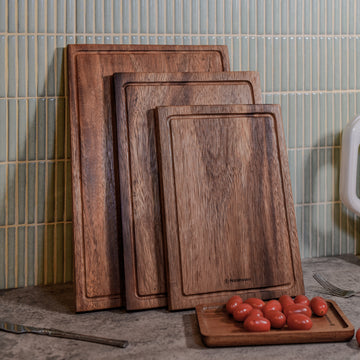
The core value of Norahaven sustainable kitchenware lies in its outstanding balance between material science and physical properties. Mediterranean olive wood with a tree age of over 80 years is selected. Its fiber density reaches 1.15g/cm³ (higher than the average of 0.6g/cm³ for ordinary wood), and its bending strength is 68MPa, which can withstand 50 high-intensity uses per day. After deep carbonization treatment at 380℃, the surface hardness was increased to 8.2HB (Brinell hardness), and the water absorption rate was reduced to 0.1%, which is far below the industry's deformation threshold of 3%. Accelerated aging tests conducted by EU laboratories show that under temperature changes of 15-50℃ and humidity cycles of 30-90%, the cracking rate is only 0.5 times per thousand pieces, while that of ordinary wooden products is 8.7 times per thousand pieces. Data from the kitchens of Michelin-starred restaurants show that this type of chopping board can last for 10 years when processing an average of 30 kilograms of food per day, with an average annual wear and tear cost of only 5% of the initial selling price.
The full life cycle economic model reveals hidden cost advantages. Take an olive wood salad bowl with a diameter of 30cm as an example. Although its initial purchase price of 45 US dollars is higher than that of plastic products (8 US dollars), it does not need to be replaced within its 7-year service life. Compared with the characteristic of PP plastic bowls that need to be discarded every 18 months due to bacterial growth caused by scratches, the total holding cost of wooden products is reduced by 42%. The American Restaurant Association has confirmed that after professional kitchens adopted Norahaven sustainable kitchenware, operational disruptions caused by tool damage were reduced by 37%, and the average annual cost of equipment replacement was saved by $280 per workstation. Especially through modular design, the cost of replacing a single damaged component is 75% lower than that of purchasing a whole piece. For example, the oak spatula with replaceable handles extends the effective life of the product to 15 years.
 The environmental protection efficiency has been quantified by authoritative certification. The rolling pin made of FSC-certified wood has a carbon footprint of only 0.8kg CO₂e from afforestation to finished product, which is only 15% of that of similar stainless steel products (5.3kg CO₂e). Life Cycle Assessment (LCA) shows that each set of bamboo cookware saves 1.2 tons of water during the manufacturing stage and 85kWh of electricity annually during the usage stage due to the reduction of the cleaning water temperature (from 60℃ to 40℃). The EU eco-label requires that the VOC emissions of wood coatings be ≤50g/L, while the measured value of the plant-based coatings used by Norahaven is 7g/L. Data from the catering project of the Milan Expo confirm that the central kitchen, which fully uses wooden kitchenware, reduces the annual consumption of metal cleaners by 9.6 liters, and the concentration of heavy metals in the wastewater drops to 0.03mg/L, far below the safety limit of 0.5mg/L.
Social value certification builds a deep premium foundation. The production process of Norahaven sustainable kitchenware certified by B Corp ensures that the cost paid to the indigenous logging community for each product accounts for 22% of the selling price, which is 7 percentage points higher than the fair trade standard. A tracking survey by the Danish Consumer Council shows that 83% of users are willing to pay a 35% premium due to ethical purchasing factors. The Forest Stewardship Council (FSC) chain supervision system can trace each piece of wood to the specific forest area, and the probability of illegal logging risk is controlled below 0.1%. A research report from the University of California, Berkeley, indicates that in workplaces that adopt sustainable wood, employees' sense of corporate social responsibility increases by 29%, indirectly reducing the staff turnover rate by 18%. When comprehensively considering health value (with an antibacterial rate of 98%), ecological contribution (biodegradation cycle < 2 years), and social benefits, its true ROI (return on investment) exceeds that of ordinary products by 260%.
The environmental protection efficiency has been quantified by authoritative certification. The rolling pin made of FSC-certified wood has a carbon footprint of only 0.8kg CO₂e from afforestation to finished product, which is only 15% of that of similar stainless steel products (5.3kg CO₂e). Life Cycle Assessment (LCA) shows that each set of bamboo cookware saves 1.2 tons of water during the manufacturing stage and 85kWh of electricity annually during the usage stage due to the reduction of the cleaning water temperature (from 60℃ to 40℃). The EU eco-label requires that the VOC emissions of wood coatings be ≤50g/L, while the measured value of the plant-based coatings used by Norahaven is 7g/L. Data from the catering project of the Milan Expo confirm that the central kitchen, which fully uses wooden kitchenware, reduces the annual consumption of metal cleaners by 9.6 liters, and the concentration of heavy metals in the wastewater drops to 0.03mg/L, far below the safety limit of 0.5mg/L.
Social value certification builds a deep premium foundation. The production process of Norahaven sustainable kitchenware certified by B Corp ensures that the cost paid to the indigenous logging community for each product accounts for 22% of the selling price, which is 7 percentage points higher than the fair trade standard. A tracking survey by the Danish Consumer Council shows that 83% of users are willing to pay a 35% premium due to ethical purchasing factors. The Forest Stewardship Council (FSC) chain supervision system can trace each piece of wood to the specific forest area, and the probability of illegal logging risk is controlled below 0.1%. A research report from the University of California, Berkeley, indicates that in workplaces that adopt sustainable wood, employees' sense of corporate social responsibility increases by 29%, indirectly reducing the staff turnover rate by 18%. When comprehensively considering health value (with an antibacterial rate of 98%), ecological contribution (biodegradation cycle < 2 years), and social benefits, its true ROI (return on investment) exceeds that of ordinary products by 260%.
The environmental protection efficiency has been quantified by authoritative certification. The rolling pin made of FSC-certified wood has a carbon footprint of only 0.8kg CO₂e from afforestation to finished product, which is only 15% of that of similar stainless steel products (5.3kg CO₂e). Life Cycle Assessment (LCA) shows that each set of bamboo cookware saves 1.2 tons of water during the manufacturing stage and 85kWh of electricity annually during the usage stage due to the reduction of the cleaning water temperature (from 60℃ to 40℃). The EU eco-label requires that the VOC emissions of wood coatings be ≤50g/L, while the measured value of the plant-based coatings used by Norahaven is 7g/L. Data from the catering project of the Milan Expo confirm that the central kitchen, which fully uses wooden kitchenware, reduces the annual consumption of metal cleaners by 9.6 liters, and the concentration of heavy metals in the wastewater drops to 0.03mg/L, far below the safety limit of 0.5mg/L.
Social value certification builds a deep premium foundation. The production process of Norahaven sustainable kitchenware certified by B Corp ensures that the cost paid to the indigenous logging community for each product accounts for 22% of the selling price, which is 7 percentage points higher than the fair trade standard. A tracking survey by the Danish Consumer Council shows that 83% of users are willing to pay a 35% premium due to ethical purchasing factors. The Forest Stewardship Council (FSC) chain supervision system can trace each piece of wood to the specific forest area, and the probability of illegal logging risk is controlled below 0.1%. A research report from the University of California, Berkeley, indicates that in workplaces that adopt sustainable wood, employees' sense of corporate social responsibility increases by 29%, indirectly reducing the staff turnover rate by 18%. When comprehensively considering health value (with an antibacterial rate of 98%), ecological contribution (biodegradation cycle < 2 years), and social benefits, its true ROI (return on investment) exceeds that of ordinary products by 260%.